
Our Story
The beginning
Wilderness Committee origin stories are many. But generally we agree that, whether around a campfire or a kitchen table, a small group of committed activists from southern Vancouver Island met up with a group of residents from the islands of Haida Gwaii, including members of the Haida Nation, to protect the spectacular South Moresby wilderness area.
Those initial encounters led to a long-term friendship between Wilderness Committee founder Paul George and legendary Haida leader Guujaaw. In the following years, this relationship led to joint expeditions out on the land, photos of clearcuts, mapping of protected area proposals, the production of a book, public education materials and government advocacy.
That work began in 1976 and led not only to the 1985 Haida Heritage Site designation, and the 1993 establishment of the Gwaii Haanas National Park Reserve that protects an archipelago of 138 islands including Moresby Island, but to the founding of the Wilderness Committee in 1980, a registered non-profit and a federal charity.
45 years later
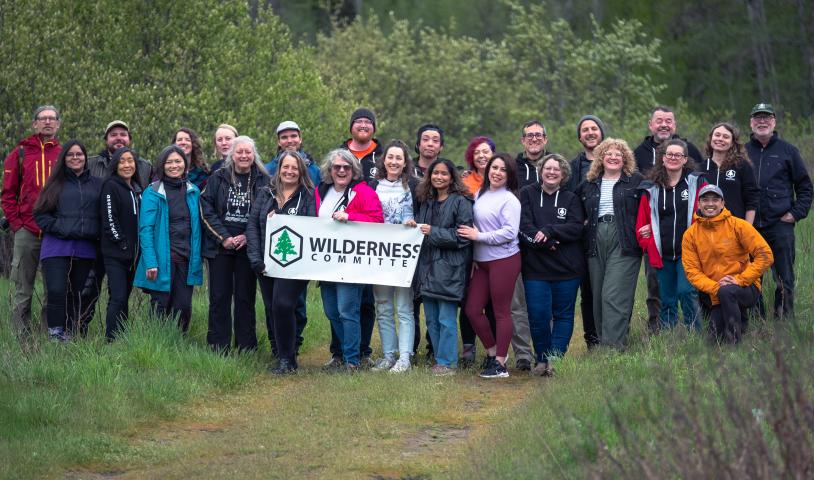
Today, 45 years later, supported by 50,000 supporters, volunteers and activists from coast to coast to coast, we are united in our mission to protect life-giving biological diversity through collaborative grassroots mobilization that transforms systems. We believe:
- Healthy nature is vital to thriving communities and biodiversity
- People taking informed action together create change
- Relationships with communities and the land ground our work
- Solutions challenge systems to create equity and justice for all
As the organization expanded across Canada over the years, today with offices in Vancouver, Victoria, Winnipeg and Toronto, we're able to successfully advocate for nature protection, defend at-risk wildlife and fight for a stable and healthy climate.
It's the combined voices of these supporters, joined by our partners, friends and allies across the country, that has allowed the Wilderness Committee to:
- Establish millions of hectares of protected areas
- Participate in dozens of successful court actions in defense of endangered species and wilderness areas
- Construct hundreds of kilometres of hiking trails into some of the most vital wild areas, through volunteer-driven multi-day field trips
- Partner with dozens of First Nations communities on projects to protect traditional and unceded territories, including the renowned tribal park model
- Publish and distribute nearly 200 editions of free educational newspapers, 55 wilderness and wildlife calendars, numerous books, posters, videos, technical briefs, research documents, and maps
- Develop and present hundreds of lectures, slide shows, and briefs for public hearings, government meetings, school presentations, and community events, reaching over 100,000 people each year
- Engage thousands of volunteers in hands-on projects, and inspiring many to become knowledgeable, passionate environmental advocates
- Facilitate concrete actions taken by tens of thousands of activists and supporters to gain legislation to protect wild places
How we work
The original campaign to protect an old-growth wilderness area had all the makings of what came to be two foundational viewpoints that remain true today at the Wilderness Committee:
- Saving nature depends upon people’s understanding of wild places and the industrial resource extraction that threatens them. Information, insights and images were the key to modifying people's understanding and perceptions and working towards conservation.
- Indigenous Nations from the territory, as well as scientific knowledge and local community participation, are integral to the preservation of nature. In particular, as the traditional title holders, Indigenous peoples’ rights and historical knowledge, use of the lands and stewardship of ecosystems, must lead the way in any protected area process.
“There’s no magic formula. It takes constant hard work, an innovative team of people and long-term commitment to achieve social change.”
~Paul George, Wilderness Committee founder
The only way this happens is by putting in the time and effort, in communities and on the land, to build the type of strong relationships — the trust — that allows us to work side by side with Indigenous community members, whether to project legendary wilderness areas, stop the destruction of at-risk species habitat, or fight the unsustainable industrial extraction model that prioritizes short-term profit over long-term environmental and social health and sustainable economic development that centres Indigenous Nations and community needs.
From the Haida Nation to the Nuu-chah-nulth Nations in Clayoquot Sound, to the Lytton, Lil’wat and Spô'zêm Nations in the Fraser Canyon, to the Tsilhqot'in and Secwépemc Nations in the interior of B.C., to Hollow Water First Nation in the Heart of the Boreal in Manitoba, to Serpent River First Nation on the shores of Lake Huron in Ontario, relationship building with First Nations members has always been front and centre. Each story is different, but over the decades we have learned the importance of working in a good way when collaborating with local communities and Nations.
“I believe there is a thing that goes on in human beings. They want to know how strongly you believe in something. They want to know how determined you are. They want to know if you’ve thought it through. They want to know if you’ll stand your ground. You’ve got to do it right.”
~Joe Foy, first Wilderness Committee staff member
Building relationships in order to work side by side for a common goal takes intention, time and resources. It takes collaborating in a variety of different ways depending on the needs of a community. Over the past four decades this collaboration has looked like printing, designing and publishing joint educational information, posters or advocacy materials, contributing mapping, graphic design and communications resources, providing photos or producing videos, working on the ground in community gardens or building and maintaining trail infrastructure, bringing scientific knowledge and expertise, giving community slideshows and presentations, attending town hall meetings, and meeting with government officials. Or just being there. And being a good friend.
“The Wilderness Committee is in many ways like the Union of BC Indian Chiefs. They can be relied upon to show up and defend the natural values that make B.C. one of the most beautiful places in the world. It’s that deep sense of commitment and dedication to the integrity of the environment and everything that represents. It is a common value that the Wilderness Committee shares with First Nations peoples and First Nations organizations that have stood on the front line to protect the integrity of the environment throughout our territories.”
~Grand Chief Stewart Phillip, President, Union of BC Indian Chiefs
Forty-five years later, here we are at a turning point. The protection of iconic wild areas and vital ecosystems is more critical to our survival than ever — the loss of biodiversity and climate chaos threaten everything we love. The solution is to protect a minimum of 30 percent of lands and waters by 2030. In partnership with Indigenous peoples, in whose territories every forest grows, every river roars and every species lives, this path forward is possible.
Our current strategic plan reflects where we are headed in terms of strengthening the organization and the impact of our work.