Federal government taken to court over 11‑year delay in protecting Caribou habitat
Monday, February 9, 2026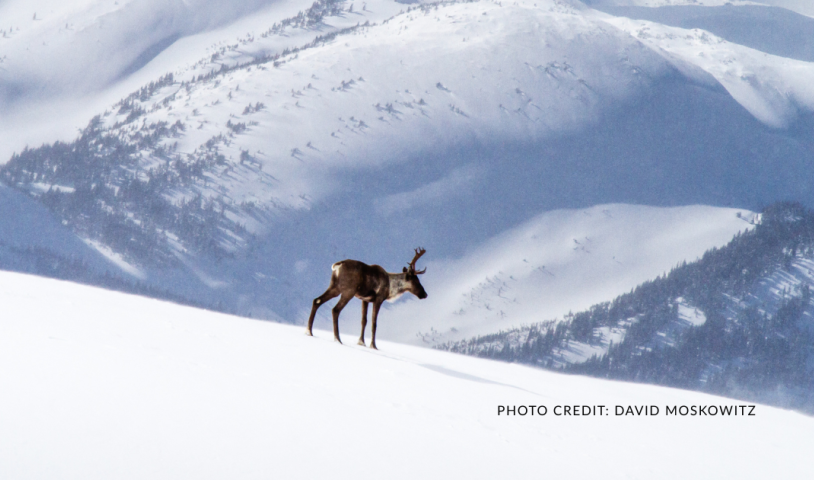
After more than a decade of broken promises, environmental groups say delay is driving iconic species toward extinction
VANCOUVER / Unceded xʷməθkʷəy̓əm (Musqueam), Sḵwx̱wú7mesh (Squamish) and səlilwətaɬ (Tsleil-Waututh) Territories: Today, Ecojustice, representing Stand.earth, Wildsight and Wilderness Committee, is taking the Government of Canada to court over its more than 11-year delay in fully mapping critical habitat for threatened Southern Mountain Caribou. Habitat mapping is a necessary first step under the Species at Risk Act (SARA) to protect and recover caribou and other threatened and endangered species.
For thousands of years, Southern Mountain Caribou moved freely through old-growth forests in British Columbia and Alberta. These iconic animals are now fast disappearing due to habitat loss, fragmentation and widespread changes in their ecosystems. In southern and central British Columbia, 8 of 18 herds have already gone locally extinct.
"At this point, extinction is not accidental; it is a political choice, and this lawsuit is our refusal to accept it,” - Lucero González, Conservation and Policy Campaigner at Wilderness Committee
Southern Mountain Caribou have been listed as a threatened species for over two decades. Under SARA, the federal government must fully identify the critical habitat the species needs to survive and recover so they can take steps to protect that habitat. But effective habitat protection cannot happen without full, accurate maps — and those maps remain unfinished.
In 2014, in response to Ecojustice litigation, the federal government released a long-overdue recovery strategy for Southern Mountain Caribou that included only partial habitat mapping. The government promised to complete the work by the end of that year. More than a decade later, that promise remains broken.
During this delay, logging and industrial development have continued — and, in some cases, increased — across caribou habitat. Old-growth forests have been clearcut, and remaining herds pushed closer to extinction. While some herds show promising signs of recovery, their success depends largely on having their critical habitat protected before it’s too late.
“The federal government is undermining the purposes of the Species at Risk Act, namely the protection and recovery of Canada’s threatened wildlife,” said Ecojustice lawyer Sean Nixon. “The government’s ongoing failure to finish habitat mapping for Southern Mountain Caribou – more than two decades after the species was listed – is causing serious harm to an iconic Canadian species.”
Environmental groups warn this pattern has played out before.
“It is now clear to us that without accountability and legal action, the federal government will delay protecting Southern Mountain Caribou for as long as they can. We are done waiting,” said Lucero González, Conservation and Policy Campaigner at Wilderness Committee. “We have already seen the consequences of Canada’s inaction in British Columbia, where the failure to map and protect critical habitat pushed the spotted owl to the edge of extinction. At this point, extinction is not accidental; it is a political choice, and this lawsuit is our refusal to accept it.”
“We’re taking the Minister to court with heavy hearts in memory of the South Selkirk, South Purcell, Central Purcell, Monashee, Frisby, Central Rockies, George Mountain, and Columbia South caribou herds,” said Eddie Petryshen, Conservation Specialist at Wildsight. “We cannot allow more localized extinctions to happen; the federal government must step up and fulfill its responsibility to protect this iconic and threatened species."
"Eleven years is far too long to wait for the federal government to fulfil its duty,” said Tegan Hansen, Senior Forest Campaign at Stand.earth. “While the ministry responsible drags its feet, we’re watching some Southern Mountain Caribou herds vanish entirely. It shouldn’t take a lawsuit for the government to meet its obligations, but we don’t have another decade to waste if we want this species to survive. That’s why we’re headed to court."
The lawsuit asks the Federal Court to declare that the federal environment minister’s delay in completing critical habitat mapping is unreasonable and unlawful. A ruling could force action not only for caribou, but for many other endangered and threatened species still waiting for protection.
-30-
Media contacts:
Lucero González, Wilderness Committee, lucero@wildernesscommittee.org
Shayoni Mehta, Ecojustice Canada, smehta@ecojustice.ca
Eddie Petryshen, Wildsight, 250-427-9885, eddie@wildsight.ca
Tegan Hansen, Senior Forest Campaigner, Stand.earth (English, French): tegan@stand.earth (Pacific Time)
Kathryn Semogas, Communications Specialist, Stand.earth (English): kathryn.semogas@stand.earth, 778-653-2303 (Eastern Time)