Explainer: Carney’s major projects push in one timeline
Tuesday, September 15, 2026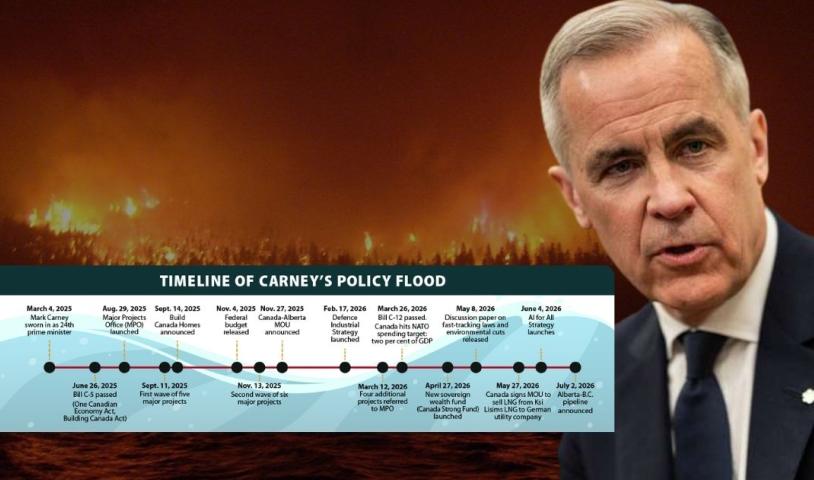
Among Prime Minister Carney’s first laws was Bill C-5, which allows the federal government to fast-track major industrial projects it deems in the “national interest.” This bill faces a constitutional challenge from several First Nations for its impact on Indigenous rights, and in July 2025, several First Nations chiefs stormed out of a meeting with Carney, condemning it as a violation of their rights. A month later, Carney opened the Major Projects Office to fast-track the reviews of large-scale industrial developments, including new pipeline proposals.
This article is fourth in a series from our Flood the Zone publication, which identifies ways community-building can combat a dangerous media tactic.
Carney has also gutted incremental climate policies that, while insufficient on their own, still held merit: the consumer carbon tax, anti-greenwashing legislation, electric vehicle mandates and the oil and gas emissions cap, to name a few. Carney himself has admitted that greenhouse gas emissions will increase over the next couple years with his new policies and projects.
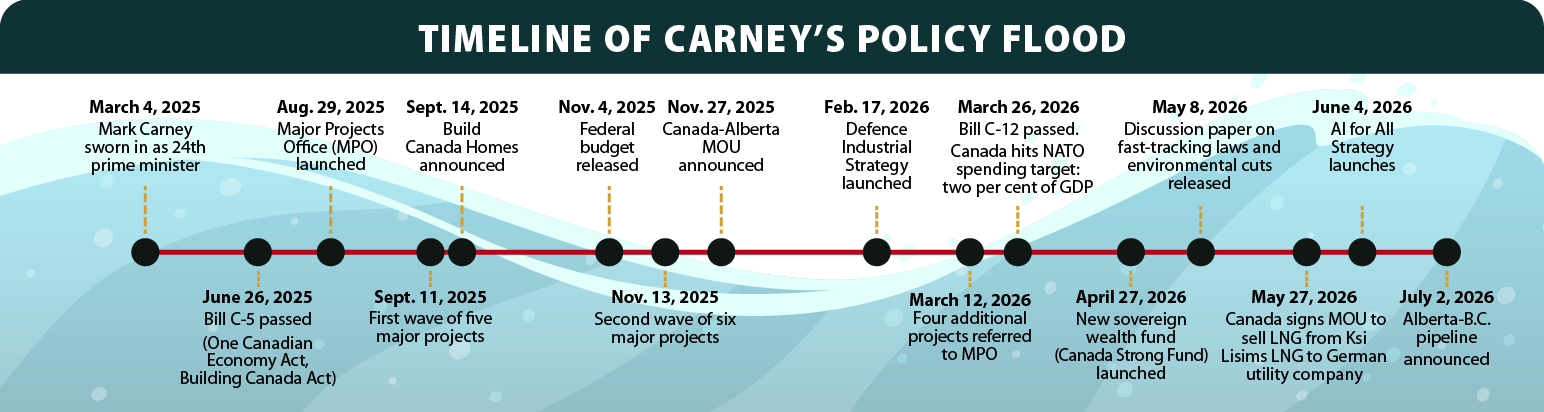
As climate change continues to displace people around the world and drive weather disasters in the Global South, Canada has an ongoing responsibility to support migrants given its outsized role in the climate crisis. Instead, Carney passed legislation like Bill C-12 which allows for the mass cancellation of some immigration permits without due process, among other restrictive measures. He’s cut healthcare for refugees and is making the immigration system tighter and ever more challenging to navigate. Worse yet, the Carney government oversaw Canada’s highest ever number of deportations in 2025 — over 23,000 people.
On foreign policy, Carney made headlines for his Davos speech about a new “principled and pragmatic” approach, but his actions on the war in Iran and Israel’s genocide in Palestine have been remarkably in line with the major powers he claims to be different from.
No matter what he wrote about in his book, Value(s), or what his former work experience might suggest, the consequences of Carney’s actions are real and how he should be judged.
As climate change continues to displace people around the world and drive weather disasters in the Global South, Canada has an ongoing responsibility to support migrants given its outsized role in the climate crisis. Instead, Carney passed legislation like Bill C-12 which allows for the mass cancellation of some immigration permits without due process, among other restrictive measures.
This article is fourth in a series from our Flood the Zone publication, which identifies ways community-building can combat a dangerous media tactic.
Click here to read the next article: How to build a better world, starting in Canada